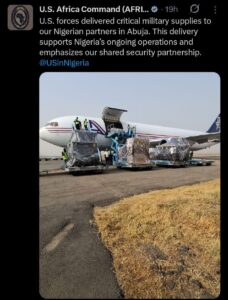
The United States Africa Command (AFRICOM) has delivered key military supplies to Nigeria in support of the country’s ongoing fight against insurgency, banditry, and other security threats. Eyes Of Lagos reports,
The military equipment was officially handed over to Nigerian security forces in Abuja, marking another step in the long-standing bilateral security partnership between both nations.
AFRICOM confirmed the delivery in a statement shared on its official X (formerly Twitter) handle on Tuesday, noting that the supplies were aimed at strengthening Nigeria’s operational capacity.
“U.S. forces delivered critical military supplies to our Nigerian partners in Abuja. This delivery supports Nigeria’s ongoing operations and emphasises our shared security partnership,” AFRICOM stated, while tagging the U.S. Embassy in Nigeria (@USinNigeria).
Although details of the equipment were not disclosed, the delivery is understood to be part of broader U.S.–Nigeria security cooperation, which includes intelligence sharing, logistics support, and specialised training for counterterrorism and stability operations across the country.
The development comes amid intensified military offensives by Nigerian forces against terrorist groups, armed bandits, and other criminal networks, particularly in the North and North-West regions, where insecurity has remained a major challenge.
AFRICOM, a unified combatant command of the United States Department of Defense, is responsible for coordinating U.S. military activities and security partnerships across Africa, with the exception of Egypt.
The latest delivery also follows a joint operation by AFRICOM and Nigerian forces on Christmas Day in Sokoto State, which reportedly led to the neutralisation of several terrorists. The operation highlighted ongoing efforts to dismantle insurgent networks and enhance regional stability.
Both the U.S. and Nigerian governments have repeatedly stressed that sustained security collaboration is vital to addressing cross-border threats, safeguarding civilians, and promoting long-term peace and stability in the region.