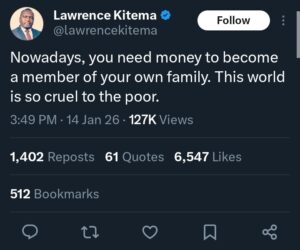
A social media user, Lawrence Kitema, has triggered widespread debate online after lamenting what he described as the growing influence of money on family acceptance and relationships.
In a post shared on X (formerly Twitter), Kitema expressed frustration over what he sees as increasing cruelty toward poor people, claiming that financial status has become a determining factor for respect and inclusion—even among family members who are expected to offer unconditional support. Eyes Of Lagos reports,
“Nowadays, you need money to become a member of your own family. This world is so cruel to the poor,” he wrote.
The statement quickly went viral, drawing thousands of reactions as users shared personal experiences and reflected on how economic pressure is reshaping family bonds.
Many netizens resonated with Kitema’s comment, describing situations where wealth appears to influence authority, respect, and decision-making within families.
A user identified as Esperanza wrote that a person’s worth should not be defined by their financial status, stressing that poverty is a circumstance rather than a moral failing.
Another commenter, JP Attueyi, noted that in some families, meetings and decisions revolve around the wealthiest member, whose absence or opinion determines the outcome of discussions.
Aditi added that while the situation is not entirely new, people are now more open about attaching value to money, even in places where love and kinship should prevail.
Other users approached the topic from a more pragmatic perspective, arguing that money has become a tool for survival, independence, and protection in modern society.
Ken, another respondent, stated that financial stability often provides the freedom to leave unhealthy situations and confront life’s challenges, whether one likes it or not.
Similarly, Praveen observed that as the cost of living continues to rise, affection and presence are increasingly measured by financial contribution rather than emotional connection.
Adding humour to the conversation, PapiSpit remarked that love now seems to come with a “cover charge,” joking that being financially broke can quickly relegate one to the status of a distant relative.
The ongoing discussion highlights a broader societal concern about how economic hardship and rising living costs are influencing relationships, values, and expectations within families.
As reactions continue to pour in, many agree that while money may not buy love, it increasingly determines visibility, voice, and inclusion—raising questions about compassion and humanity in today’s world.