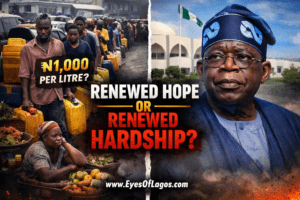
When Bola Ahmed Tinubu assumed office in May 2023, he promised Nigerians a bold economic agenda called “Renewed Hope.”
But nearly three years later, many Nigerians say the reality feels more like renewed hardship.
Across the country—from Lagos bus stops to rural farming communities—the same complaints dominate conversations: expensive fuel, rising cost of living, insecurity, and shrinking economic opportunities.
So what exactly is happening under the Tinubu administration? And why are so many citizens feeling the pressure?
This article breaks down the key issues shaping the national mood. Eyes Of lagos reports,
1. Fuel Subsidy Removal: The Decision That Changed Everything
One of Tinubu’s first major policies was the removal of fuel subsidy during his inauguration speech.
Economists had long argued the subsidy was unsustainable and draining public finances. However, the immediate impact on Nigerians was dramatic.
According to data from Nigeria’s statistics agency, petrol prices jumped sharply after the subsidy removal. The average pump price rose from about ₦206 per litre in 2022 to around ₦671 in 2023, representing an increase of more than 225%.
By late 2024 and into 2025, petrol prices climbed even higher, reaching around ₦1,000 or more per litre in many parts of the country.
The ripple effect has been massive:
-
Transportation costs surged
-
Food prices increased
-
Businesses raised prices to survive
In simple terms: fuel became the engine of inflation.
2. Inflation and the Rising Cost of Living
Nigeria’s inflation crisis worsened significantly after subsidy removal.
Studies show the country’s headline inflation rate climbed steadily through 2024, reaching over 34% — the highest level in nearly two decades.
For ordinary Nigerians, this means:
-
Food prices rising weekly
-
Rent increasing across major cities
-
Electricity and transport costs skyrocketing
In Lagos, many households now spend the majority of their income simply trying to eat and move around the city.
The situation has become so severe that the World Bank estimates about 129 million Nigerians — nearly 60% of the population — now live in poverty.
That statistic alone explains why the public frustration is growing louder.
3. Economic Growth That People Can’t Feel
Interestingly, some economic indicators have improved under Tinubu.
Nigeria’s economy recorded growth of about 4.6% in late 2024, supported by economic reforms and improved government revenue.
But here lies the real problem.
The growth is largely macro-economic—meaning it looks good on paper but is not yet improving the lives of ordinary citizens.
Labour unions and small business owners say the benefits of these reforms have not translated into real relief for Nigerians, as operating costs and consumer prices remain extremely high.
In other words:
Nigeria’s economy may be growing, but Nigerians are getting poorer.
4. The Insecurity Crisis Is Getting Worse
While Nigerians struggle economically, insecurity continues to threaten lives and livelihoods.
Recent reports show insurgent groups have intensified attacks on military bases in northeastern Nigeria, killing soldiers and seizing weapons.
Beyond terrorism, the country faces multiple security challenges:
-
Kidnapping across highways and rural communities
-
Banditry in northern states
-
Farmer–herder conflicts affecting agriculture
Research shows insecurity has already reduced agricultural production in affected regions, as farmers abandon their fields for safety.
When farmers cannot farm, food becomes scarce—and prices rise further.
This creates a dangerous cycle:
Insecurity → Less food → Higher prices → More poverty
5. The “Japa” Wave: Nigeria’s Talent Leaving
Another silent consequence of economic hardship is the mass migration of Nigerian professionals.
Doctors, engineers, tech workers, and students are leaving the country in large numbers in search of better opportunities abroad.
Many young Nigerians now believe the fastest way to succeed is not by building Nigeria—but by leaving it.
That mindset alone is a warning sign for any nation.
6. The Government’s Defense: “Reforms Take Time”
The Tinubu administration argues that the reforms are necessary and will produce long-term benefits.
Officials say the policies have:
-
Improved government revenue
-
Stabilized foreign exchange markets
-
Reduced the fiscal deficit
The government also says removing subsidies will free money for infrastructure, education, and security.
But critics say Nigerians cannot eat future promises while struggling with today’s hunger.
The Real Question Nigerians Are Asking
The central question is not whether reforms are necessary.
Most economists agree they are.
The real question is this:
Why are ordinary Nigerians carrying the full weight of the reforms while political elites appear unaffected?
Until that imbalance changes, public frustration will likely continue to grow.
The Road Ahead
Nigeria is Africa’s largest economy and one of its most resource-rich nations.
But resources alone do not build prosperity.
What Nigerians want now is simple:
-
Lower cost of living
-
Real security
-
Jobs and opportunities
-
Leadership that shares the burden of reform
If the government can translate economic reforms into real improvements in everyday life, public confidence could return.
But if hardship continues to deepen, the “Renewed Hope” agenda may risk becoming a slogan many Nigerians no longer believe.