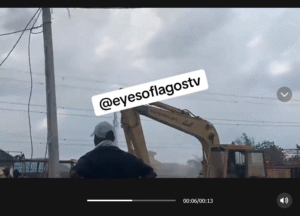
The Lagos State Government has commenced a large-scale demolition of buildings constructed under power lines along AIT Road in the Kola–Alagbado area of Lagos, sparking panic and outrage among residents and traders. The operation, which began in the early hours of Monday, saw bulldozers pull down homes, perimeter fences, and shops located beneath or close to high-tension electricity lines. Eyes Of Lagos reports,
Eyewitnesses told Eyes of Lagos that the exercise quickly turned chaotic when residents tried to resist the demolition. Police officers on site reportedly fired tear gas to disperse the crowd as bulldozers advanced through the densely populated area, clearing structures one after another. Scenes of confusion followed, with families rushing to salvage personal belongings while others watched in tears as their properties crumbled.
Several residents alleged that they were not adequately informed before the demolition commenced. “We just woke up to see bulldozers in front of our houses,” said Mrs. Adebayo, a trader whose building was affected. “They said it’s under a power line, but this house has been here for over twenty years. No one came to give us proper notice or compensation.”
The Lagos State Building Control Agency (LASBCA) had earlier stated that structures under high-tension power lines are illegal and pose significant safety risks to occupants. The agency insists that the ongoing demolition across Alagbado and neighboring communities is part of a wider city safety enforcement drive. Officials have repeatedly warned that continued habitation under live power lines could lead to electrocution or fire outbreaks, adding that residents were served notices before the exercise.
In a statement from LASBCA’s spokesperson, the agency reaffirmed that the demolitions are in accordance with the Lagos State Urban and Regional Planning and Development Law. The government also cited previous incidents where buildings constructed too close to power installations caused accidents or electrical hazards. “It is our responsibility to prevent loss of lives,” the statement said. “Buildings under power lines are high-risk and must be cleared to protect the public.”
However, affected residents argue that the demolitions are being carried out with little empathy and without a clear compensation plan. Many homeowners claim to have building approvals and documents dating back decades. A resident who identified himself as Mr. Olawale said he invested his life savings in a mini shopping complex along AIT Road, only for it to be destroyed overnight. “This is not development, this is destruction,” he lamented. “We support urban renewal, but we should not be treated like we don’t matter.”
Some protesters attempted to block the road and halt the demolition trucks but were dispersed by security forces using tear gas. Videos circulating on social media show residents coughing and fleeing as thick smoke filled the air while bulldozers continued their operation under police protection.
Community leaders in Alagbado have appealed to the state government to reconsider its approach, urging that the affected residents be properly engaged and compensated. They also requested that alternative housing or business spaces be provided for displaced families and traders. “We are not against the government,” one community representative said, “but we need a human face to this process. Many people here have nowhere else to go.”
Urban planners, meanwhile, argue that the exercise is long overdue, citing years of unregulated construction and encroachment on power line corridors. According to them, enforcement of planning laws is essential to prevent future tragedies, though they acknowledge that communication and resettlement are critical parts of the process that should not be ignored.
The demolition drive is expected to continue in phases as part of what the government calls a “safety and environmental compliance campaign.” Similar exercises have been carried out in parts of Ikorodu, Ojodu, and Egbeda in recent months.
For now, AIT Road bears the marks of heartbreak and policy in action — flattened homes, scattered belongings, and a community struggling to make sense of its new reality. While some see the move as a necessary measure for public safety and urban order, others believe it is yet another case of the powerful disregarding the vulnerable.
As dusk fell on Kola–Alagbado, smoke and dust lingered in the air while families huddled beside the ruins of what used to be their homes. Amid the silence, the debate continues: is this demolition a sign of progress, or a painful reminder of how development often comes at a human cost?
@eyesoflagostv BREAKING IN LAGOS! LASG has begun massive demolition of all buildings under power lines along AIT Road, Kola–Alagbado 😳⚡ According to reports, police just tear-gassed protesters who tried to resist the demolition and block the operation! 😱💨 Residents are in panic as bulldozers roll in — homes, shops, and fences all going down 💔🏚️ 📍Location: Kola–Alagbado, AIT Road 🎥 #EyesOfLagos What’s your take — development or oppression? 👀💭 #LagosUpdate #AITRoad #KolaAlagbado #Demolition ♬ suara asli – milenia – 🅄🅻🄸🅽🄽🆄🄷🅰