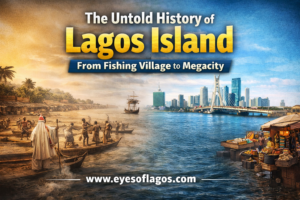
Lagos, Nigeria — Lagos Island, often regarded as the heartbeat of Nigeria’s economic and cultural landscape, has a story that stretches far beyond its modern skyline. Once a modest fishing village, it has evolved over centuries into a bustling megacity that plays a pivotal role in West Africa’s commerce, culture, and tourism. Eyes Of Lagos reports,
Early Beginnings: From Lagoon Fishing to Small Settlements
Historical records suggest that Lagos Island’s origins date back to the 15th century, inhabited by the Awori subgroup of the Yoruba people. The early settlers relied heavily on fishing and trade along the Lagos Lagoon, a natural waterway that became a conduit for cultural and commercial exchange.
The island’s early economy was shaped by:
-
Fishing and farming
-
Local crafts and trade with neighboring communities
-
Interaction with Portuguese explorers in the late 1400s, who referred to the area as “Lago de Curamo” (Lake of Curamo)
Colonial Influence and the Rise of a Trading Hub
By the 19th century, Lagos Island became central to trans-Atlantic trade, particularly after the British annexation in 1861. The colonial administration introduced:
-
Western-style architecture
-
Administrative offices
-
Commercial ports that connected Lagos Island to global trade networks
During this period, Lagos Island emerged as a vital hub for commerce, education, and governance, cementing its influence across the region.
Cultural Evolution: Festivals, Markets, and Heritage
Lagos Island is not just an economic powerhouse—it is a cultural melting pot. Its residents preserve Yoruba traditions while embracing modernity. Key cultural highlights include:
-
Eyo Festival: A traditional masquerade parade unique to Lagos Island
-
Balogun and Idumota Markets: Historic trading centers bustling with goods and stories of generations
-
Local arts and crafts: From textiles to contemporary street art, Lagos Island remains a creative hub
The blend of old and new continues to attract tourists seeking authentic cultural experiences.
Modern Lagos Island: Skyscrapers, Business, and Global Influence
Today, Lagos Island is home to skyscrapers, major banks, and international businesses, making it a financial epicenter for Nigeria and West Africa. Its skyline reflects decades of economic evolution, yet traces of its history remain in heritage sites, traditional markets, and waterfront neighborhoods.
Visitors can still experience the island’s historic Lagos Marina, Tafawa Balewa Square, and Freedom Park, where colonial buildings have been repurposed for arts and leisure, blending history with modern urban life.
Why Lagos Island Should Be on Every Visitor’s List
For tourists, Lagos Island offers:
-
A deep dive into Nigeria’s colonial and post-colonial history
-
Cultural festivals and markets alive with tradition
-
Modern entertainment, dining, and nightlife options
-
Opportunities to witness the evolution of a megacity from its roots as a fishing village
Lagos Island is a city where history and modernity coexist, making it a must-see destination for travelers and a symbol of Nigeria’s growth.