By Alphonso Olajide Babatunde
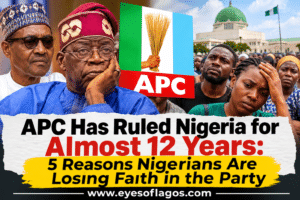
Nigeria has spent more than a decade under the leadership of the All Progressives Congress (APC), but millions of citizens are still asking one important question: Has the party delivered the better Nigeria it promised in 2015?
When the APC defeated the Peoples Democratic Party (PDP) in the 2015 presidential election, it presented itself as a political alternative capable of tackling corruption, insecurity, unemployment and economic hardship.
The party’s victory brought Muhammadu Buhari into office, with expectations that his administration would change the direction of the country after 16 years of PDP rule. Eyes Of Lagos reports,
Eight years later, Bola Ahmed Tinubu succeeded Buhari in May 2023, keeping the APC in control of the presidency.
However, more than 11 years into the party’s federal leadership, Nigerians continue to grapple with rising living costs, insecurity, unreliable electricity, mounting public debt and questions about accountability.
Although the Tinubu administration has introduced significant economic reforms, including the removal of petrol subsidies and changes to the foreign exchange system, the impact of these decisions on ordinary households remains a major subject of public debate.
Here are five major reasons Nigerians have legitimate grounds to question whether the APC has delivered on its promises after nearly 12 years in power.
1. Nigerians Are Still Battling the Cost of Living Despite Economic Promises
Perhaps the biggest reason many Nigerians are dissatisfied with APC governance is the worsening pressure on household finances.
Food, transportation, electricity, rent, school fees and other essential expenses have become major concerns for millions of families.
The situation became particularly difficult following the removal of petrol subsidies in May 2023 and the foreign exchange reforms introduced by President Tinubu.
The World Bank reported in December 2023 that petrol prices had increased by an average of 163 per cent following the subsidy removal, while the naira had depreciated significantly against the dollar.
Although the government defended the decisions as necessary steps towards correcting economic distortions, their immediate consequences were painful for ordinary Nigerians.
The World Bank subsequently warned that the reforms had increased pressure on households and businesses, stressing the need for stronger social protection to cushion vulnerable citizens.
Even with inflation easing from its earlier peaks, lower inflation does not mean prices have returned to previous levels. Nigerians are still paying considerably more for many everyday necessities.
The International Monetary Fund’s June 2026 assessment estimated that 63 per cent of Nigerians were living below the national poverty line, while approximately 27 million people faced food insecurity in the autumn of 2025.
This raises an important question: If economic reforms are improving the country’s financial outlook, how long must ordinary Nigerians wait before those improvements become visible in their daily lives?
A government should not measure economic success only by improved financial indicators. The ability of citizens to afford food, transportation and decent living conditions should also matter.
2. Insecurity Remains One of Nigeria’s Biggest Unresolved Problems
Another major reason Nigerians have continued to question APC leadership is the country’s persistent security crisis.
In 2015, the APC campaigned heavily on its ability to defeat Boko Haram and restore security across Nigeria.
However, more than a decade later, terrorism, banditry, kidnapping, communal violence and attacks on vulnerable communities remain serious national concerns.
The security situation has affected several parts of the country, with communities in the North-East and North-West particularly exposed to insurgency and armed attacks.
The Global Terrorism Index 2026 report presents another worrying picture.
According to the report, Nigeria recorded 171 terrorist incidents in 2025, compared with 120 in 2024. Terrorism-related deaths increased by 46 per cent to 750, placing Nigeria fourth among the countries most affected by terrorism.
The report also identified civilians as the most targeted group, accounting for 67 per cent of terrorism-related fatalities.
These figures raise serious questions about the effectiveness of successive security strategies under the APC-led federal government.
While insecurity is a complicated problem involving criminal networks, regional instability, intelligence failures and other factors, Nigerians have a right to expect stronger protection of lives and property.
After nearly 12 years in control of the federal government, the APC cannot continue to treat insecurity as a problem without being judged by measurable results.
How many more communities must live in fear before Nigerians can confidently say that the country is becoming safer?
3. Nigeria’s Growing Public Debt Raises Questions About Financial Accountability
Another issue that deserves serious attention is the country’s growing public debt.
When the APC assumed office in 2015, Nigeria’s total public debt stood at approximately ₦12.6 trillion, according to the Debt Management Office’s 2015 annual report.
By June 30, 2026, the Debt Management Office reported that the country’s total public debt had increased to approximately ₦166.79 trillion.
This represents a substantial increase in the nominal naira value of public debt over the period.
However, it is important to understand that exchange-rate depreciation, inflation, changes in debt coverage and new borrowing all influence the comparison. The figures should not be interpreted as a direct measure of how much more the country borrowed in real terms.
The bigger concern is what Nigerians are receiving in return for the money being borrowed.
Despite successive budgets and borrowing programmes, many communities continue to struggle with poor roads, unreliable electricity, inadequate healthcare facilities and limited economic opportunities.
The Central Bank of Nigeria’s second-quarter 2026 economic report also confirmed that the public debt stock increased by 4.67 per cent between March and June 2026, partly due to new borrowings.
This does not automatically mean borrowing is wrong. Governments sometimes need loans to finance infrastructure and development projects.
However, Nigerians deserve transparent explanations about how borrowed funds are spent, which projects they finance and whether those investments generate sufficient economic returns.
If public debt continues to rise, citizens should be able to identify the lasting improvements being created with the money.
The question is no longer simply how much Nigeria owes, but what Nigerians can point to after all these years of borrowing.
4. Electricity Supply Remains a Major Problem for Homes and Businesses

For a country aspiring to become one of Africa’s leading economies, Nigeria’s electricity situation remains difficult to defend.
Businesses, manufacturers, small-scale entrepreneurs and households continue to deal with unreliable public electricity supply.
Many business owners are forced to spend significant portions of their income on petrol and diesel generators simply to keep their operations running.
This increases production costs, makes Nigerian businesses less competitive and places additional financial pressure on consumers.
The Nigerian Electricity Regulatory Commission’s 2024 annual report revealed that the national grid experienced nine system collapses during that year, including full and partial collapses.
The situation did not disappear in 2025. NERC’s 2025 annual report recorded two grid-collapse incidents during the year.
The power sector also continues to face challenges involving ageing infrastructure, gas supply constraints, liquidity problems and transmission limitations.
The World Bank has previously estimated that unreliable electricity costs Nigeria approximately $29 billion annually, highlighting the enormous economic consequences of the problem.
Successive APC administrations have had years to demonstrate meaningful improvements in electricity generation, transmission and distribution.
Although the government has introduced electricity reforms, including the Electricity Act 2023, Nigerians are still waiting for a system that can reliably support homes, industries and businesses.
A country cannot seriously talk about industrialisation and economic growth when entrepreneurs must spend heavily to generate their own electricity.
If Nigerians must continue buying fuel to power their businesses despite paying electricity bills, where exactly is the promised improvement in the power sector?
5. Questions About Corruption, Transparency and Accountability Have Not Disappeared
One of the major reasons the APC gained national support in 2015 was its promise to fight corruption and promote accountability in public office.
The party presented itself as an alternative to a political system many Nigerians believed had failed to manage public resources responsibly.
However, concerns about corruption and transparency remain significant.
Transparency International’s Corruption Perceptions Index 2025 gave Nigeria a score of 26 out of 100, placing the country 142nd out of 182 countries assessed.
The index measures perceived levels of public-sector corruption. It does not establish that every government official is corrupt or prove wrongdoing by a particular administration.
Nevertheless, Nigeria’s position demonstrates that the country continues to face a serious public-sector integrity challenge.
For Nigerians, the issue goes beyond arresting suspects or announcing anti-corruption investigations.
Citizens want to see consistent enforcement of the law, transparent public procurement, responsible management of government funds and accountability regardless of political affiliation.
The public also deserves clear explanations whenever allegations involving public resources emerge, particularly when they concern people holding influential government positions.
A credible anti-corruption campaign should not appear selective or dependent on political relationships.
After nearly 12 years of APC leadership, Nigerians are entitled to ask whether the fight against corruption has produced the institutional changes the party promised.
Anti-corruption promises mean little if citizens cannot see consistent transparency and accountability in the management of public resources.
So, Can Nigerians Still Trust the APC?

The question of whether Nigerians can trust the APC is bigger than party loyalty or political propaganda.
It is about performance, accountability and whether the promises made to citizens have translated into meaningful improvements in their lives.
To be fair, the Tinubu administration can point to some economic improvements. The World Bank reported stronger economic growth, while the IMF acknowledged that reforms introduced over the past three years have improved some macroeconomic indicators and strengthened economic resilience.
The World Bank also reported real GDP growth of 4.2 per cent in the first half of 2026.
These developments deserve recognition. However, economic growth and improved foreign reserves must ultimately translate into better living conditions, more jobs, affordable food and stronger public services.
There is also an important distinction between the Buhari and Tinubu administrations. Both belong to the APC, but their policies and decisions are not identical. Nevertheless, the party has controlled the federal government throughout this period and must accept responsibility for its overall record.
Nigerians should not be expected to judge a political party solely by campaign promises, political speeches or announcements of new policies.
They should judge it by what has changed in their communities, their businesses, their families and their personal finances.
After nearly 12 years in power, the APC must answer some difficult questions:
-
Why are millions of Nigerians still struggling to afford basic necessities?
-
Why does insecurity continue to threaten communities and livelihoods?
-
Where are the measurable benefits of the country’s growing public debt?
-
Why does reliable electricity remain a luxury for many households and businesses?
-
What has changed significantly in the fight against corruption and public-sector accountability?
Ultimately, Nigerians do not owe any political party permanent loyalty. Political trust must be earned through results, transparency and responsible leadership.
The APC has had nearly 12 years to demonstrate that it can deliver a better Nigeria. The next question is whether Nigerians believe the results justify another opportunity.