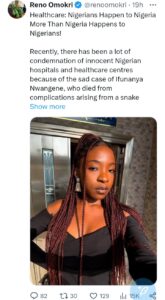
Former presidential aide and social commentator, Reno Omokri, has stirred widespread reactions online after questioning Nigerians who blame the government and hospitals for medical tragedies, asking whether they contribute enough through taxes and health insurance to demand world-class healthcare.
Omokri’s comments followed public outrage over the death of fast-rising singer Ifunanya Nwangene (popularly known as Nanyah), who reportedly died after suffering complications from a snake bite when several hospitals allegedly declined to treat her. A similar controversy had earlier trailed the death of Arise TV journalist, Somtochukwu Christelle Maduagwu, before further findings cleared medical personnel of wrongdoing. Eyes Of Lagos reports,
Reacting in a lengthy statement, Omokri expressed sympathy for the victims and their families but argued that many of the criticisms directed at hospitals are often emotional rather than practical.
According to him, healthcare delivery—especially in private hospitals—is not a charity service and must be sustainably funded to function effectively.
Omokri explained that private hospitals operate under strict financial realities, noting that treating patients without insurance, payment, or a financial guarantor often exposes hospitals to unpaid bills, legal disputes, and reputational damage.
He claimed that many Nigerians abandon hospitals after treatment without settling their bills, and when pressured, resort to social media campaigns that paint hospitals as heartless, often attracting public sympathy and police intervention.
This, he argued, is why many hospitals hesitate to provide emergency care without financial guarantees.
The former presidential aide urged Nigerians to enroll in health insurance schemes, including the National Health Insurance Authority (NHIA) or private insurance providers, stressing that emergency healthcare access largely depends on preparedness.
“People cannot expect hospitals to invest expensive, life-saving treatments on patients who have no insurance, no funds, and no guarantors,” he said, adding that responsibility lies with individuals to plan for emergencies.
Omokri also questioned the popular belief that Nigeria is an oil-rich country capable of funding world-class healthcare for free.
Using economic comparisons, he argued that Nigeria’s oil revenue, when divided among its over 230 million population, makes the country far from wealthy. He contrasted Nigeria with countries like Qatar, which has a much smaller population but significantly higher oil income per capita.
He further noted that in developed countries often referenced by Nigerians, citizens pay high taxes—sometimes up to 38% of income—and unpaid medical bills are aggressively recovered through courts, asset seizure, wage garnishment, or immigration sanctions.
Omokri concluded by challenging Nigerians who demand advanced healthcare systems without paying taxes, contributing to insurance schemes, or saving for emergencies.
He warned that without tax compliance, insurance culture, and personal financial responsibility, healthcare crises will continue to recur, regardless of public outrage.
“If you can afford luxury phones, nightlife, and expensive lifestyles but have no health insurance or emergency savings, then something is fundamentally wrong,” he stated.
His remarks have since generated intense debate across social media platforms, with many agreeing on the need for insurance reform, while others argue that emergency healthcare should never be denied regardless of financial status.