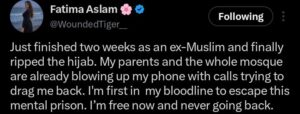
A woman has sparked intense debate across social media after revealing that she left Islam and decided to stop wearing the hijab, claiming the decision has led to persistent calls from her family and members of her former mosque urging her to return.
The woman shared her story on X (formerly Twitter), where she described reaching a personal milestone after spending two weeks as an ex-Muslim. Eyes Of Lagos reports,
According to her post, removing the hijab symbolized what she described as a new chapter in her life. She also claimed she was the first member of her family to leave the religion.
“Just finished two weeks as an ex-Muslim and finally ripped the hijab,” she wrote.
She further alleged that her decision quickly drew attention from relatives and members of her former religious community.
“My parents and the whole mosque are already blowing up my phone with calls trying to drag me back,” she claimed.
The woman also expressed her personal feelings about leaving the faith, describing it as an act of liberation.
“I’m first in my bloodline to escape this mental prison. I’m free now and never going back,” she added.
Social Media Reacts
The post quickly gained traction online, attracting thousands of views and generating heated discussions among users.
Many people defended the woman’s right to choose her own religious beliefs and personal lifestyle, arguing that freedom of religion also includes the freedom to leave a religion.
Others strongly disagreed with her comments, particularly her description of Islam, saying they found her remarks offensive and disrespectful toward the faith.
As the conversation spread across social media, opinions remained sharply divided, highlighting the sensitive nature of discussions surrounding religion, personal identity, and freedom of belief.
At the time of publication, the woman’s claims had not been independently verified. There has also been no public response from her family or representatives of the mosque she referenced in her post.
The story continues to fuel conversations online about religious freedom, family expectations, and the challenges some individuals face when changing or leaving their faith.
As with many viral social media posts, readers are encouraged to treat unverified personal claims with caution until additional information becomes available.